2025 / Graduation design / Spatial narrative & digital exhibition
The Paper Kite Cube
A digital pop-up exhibition bringing kite heritage into everyday campus life
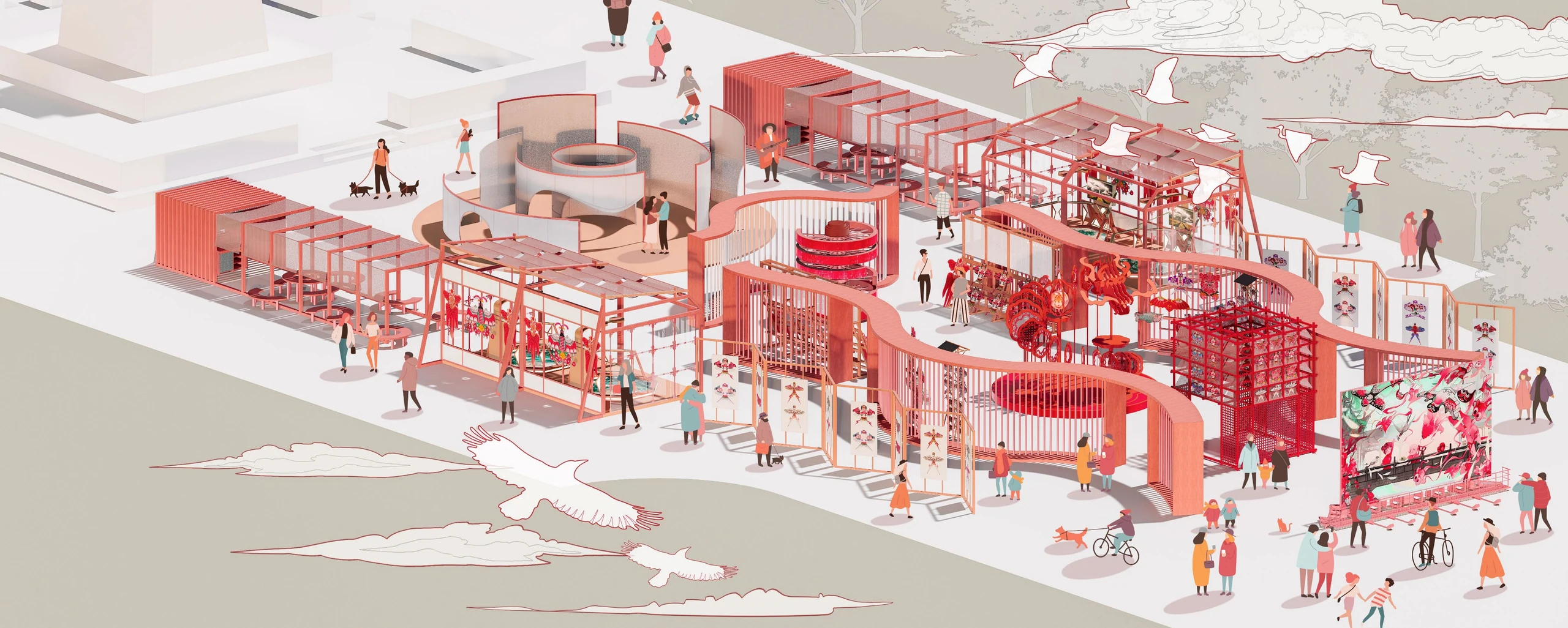
Set within the campus community of Huazhong University of Science and Technology, this project translates the frames, patterns, and flight of Chinese kites into exhibition modules that can be dismantled and recombined. Audience routes and cultural research inform four settings—gate square, student shopping centre, outdoor playground, and teaching space—connecting observation, making, and digital experiences through an open-ended cultural narrative.
2025 graduation design. Deliverables include cultural and site research, a modular system, four spatial proposals, and visualisations. AR, VR, and the digital platform are proposed experience designs.
- My contribution
- Cultural and site research, spatial narrative, module design, and visualisation
- Project stage
- Research, spatial proposals, plans, elevations, and visualisations; digital experiences are proposed designs
Context & cultural brief
How might heritage become part of campus life, beyond the display case?
Chinese kites are the subject of this project, addressing limited participation in conventional displays, the distance between cultural content and everyday life, and digital media without a clear context. Temporary, movable pop-up exhibitions offer a way to bring heritage into the campus community.
Observation without participation
Static displays can leave visitors looking at objects without experiencing the craft or stories behind them.
↳ Move from viewing towards making, exploration, and bodily participation.
A gap between heritage and daily life
Dedicated exhibitions require a planned visit, while campus free time is scattered across journeys, class breaks, and leisure.
↳ Place pop-up nodes within existing everyday routes.
Disconnected spatial and digital content
Adding a screen does not automatically create a narrative: each medium needs a cultural reference and a purposeful visitor action.
↳ Give each kite characteristic a corresponding mode of experience.
Sustaining heritage through participation
The campus is understood as a community shared by students, staff, and residents. A kite can be both a cultural symbol and a medium for making, conversation, and leisure. Exhibition nodes therefore accommodate everyday movement as well as different levels of participation.
The cultural material: history, craft & symbolism
The cultural research examines history, making, form, and motifs. Frames and strings embody structure and balance, while paper and painting carry imagery and symbolism. These characteristics later inform the spatial frames, display surfaces, interaction themes, and connections between nodes.
- 01
Frame making
Construct the frame and balance
- 02
Paper covering
Create the surface for imagery
- 03
Painting
Add motifs, colour, and symbolism
- 04
Rigging
Connect handling and flight
Open the complete research framework
Campus, people & daily routes
Understand how people move before deciding where cultural encounters happen.
The site research maps accommodation, teaching and shopping facilities, sports grounds, and open spaces at Huazhong University of Science and Technology. Everyday routes and possible stopping points inform four settings: the gate square, student shopping centre, playground, and teaching space, each with a different footprint and rhythm of use.
Three audiences, different rhythms of participation
Students
Frequent movement between accommodation, teaching, shopping, and sports spaces suggests brief visits and exploration with friends.
↳ Visible entrances and optional routes allow a single module to become the start of a longer visit.
Staff
Work and teaching create relatively fixed routes; participation should fit around movement and breaks.
↳ Compact viewing and digital experiences near teaching spaces reduce the need for a special trip.
Residents & families
Green spaces, leisure, and family activities create another campus rhythm, with a need for shared making and time to stay.
↳ Workshops, rest pavilions, and open grounds support participation together.
The same content need not occupy the same footprint everywhere. Independently accessible modules suit short visits, workshops support longer engagement, and shared visual and digital cues connect the settings.
Discovery starts beyond the site
Posters, notices, and social platforms provide information before a visit. Visible kite structures allow passers-by to discover the event without planning ahead. The design considers both finding the exhibition and choosing to stop when passing it.
Scanning and digital content are proposed to link the nodes, extending an encounter to mobile and leaving a cue for the next setting.
View the original audience and space-use analysis
These are research and observation charts from the graduation project. The source does not document a complete sample size, collection date, or statistical method; they are retained as research records rather than current campus statistics or validated audience proportions.
From kite to spatial experience
Translate the logic of a kite into an experience, beyond its silhouette.
Hard-wing, flat, three-dimensional, and string kites are decomposed into frames, load relationships, surfaces, and repeated units. Symmetry and support inform the spatial frame, painted surfaces inform display interfaces, and flight and linkage become themes for virtual experiences and exploration across nodes.
Make structure a cultural cue
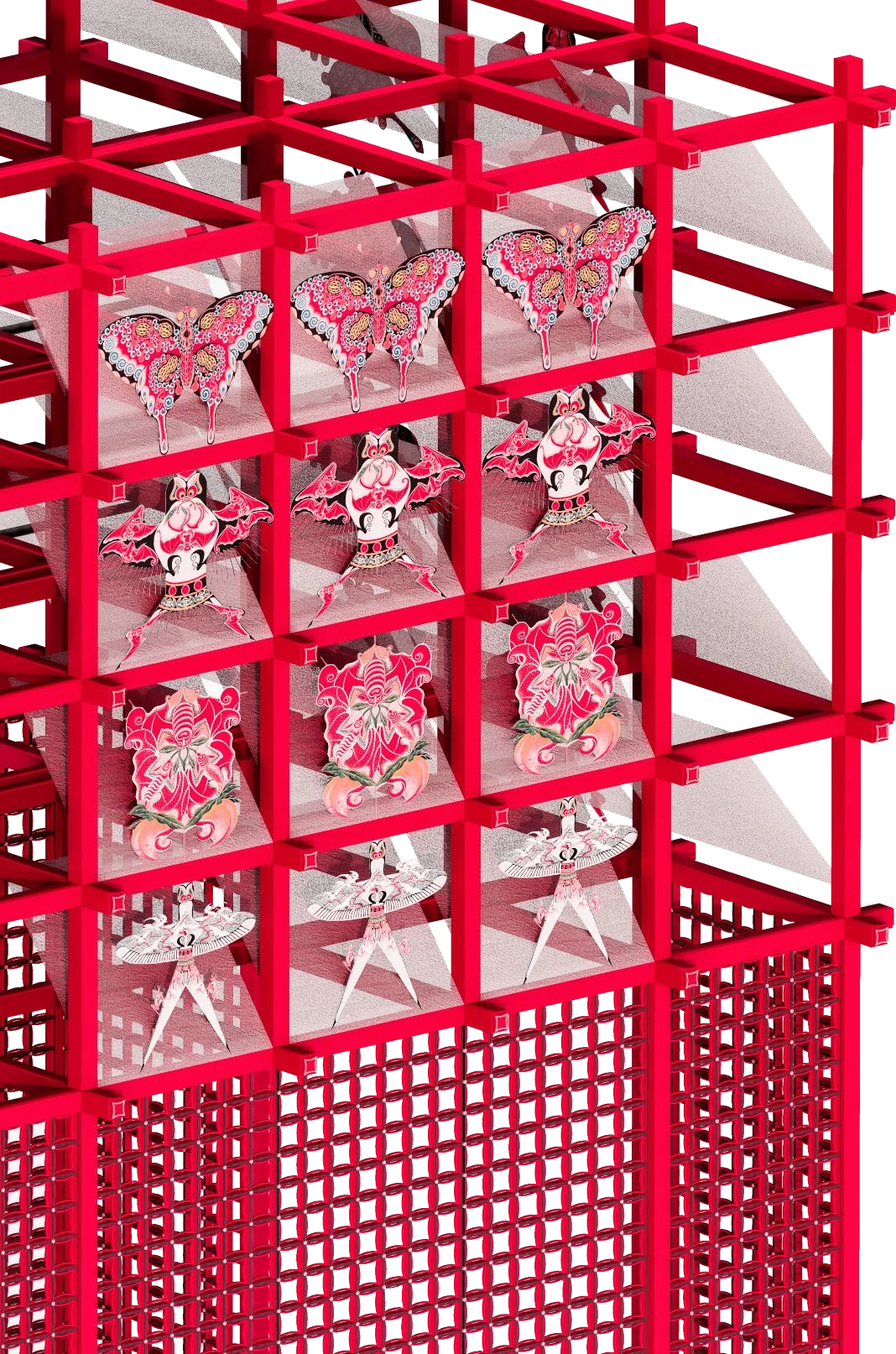
Latticework, crossed supports, symmetrical silhouettes, and repeated suspended displays carry through the proposal. Red frames, translucent surfaces, and kite motifs give settings of different scales a recognisable shared identity.
Motif studies include longevity symbols, clouds, butterflies, swallows, dragons, and flowers. They inform installation silhouettes, wayfinding, and content categories as well as decorative surfaces.
Four kite types, four experience translations
Virtual flight experience
The sense of direction and bodily imagination associated with kite flying becomes a VR theme. Symmetrical spatial frames retain the kite’s structural character as visitors move from observing a kite to imagining flight with it.
See the related space ↗Digital projection wall
The patterned surface becomes a display interface for cultural content. Projection, light, and screens carry motifs and stories, rather than functioning as unrelated technical additions.
See the related space ↗Dynamic interactive installation
The assembly of a three-dimensional frame suggests movement around an installation, revealing layers and construction from different viewpoints. The digital interaction centre and frame installations provide spatial focal points.
See the related space ↗AR-linked cultural nodes
The continuous structure becomes a multi-stop campus journey. On-site scanning, mobile content, and check-ins are proposed to link separate settings, allowing one encounter to lead to another visit.
See the related space ↗Narrative, modules & digital strategy
Recombine the content while keeping the narrative connected.
Spatial narrative brings together setting, time, and events. Independently accessible modules replace a single fixed route: a visitor can encounter motifs before making or exploring digital content, while the dispersed campus nodes share content and an identity system.
- 01
Discover
Encounter the kite frames along a daily route, or discover the event through campus notices, posters, and social channels.
- 02
Understand
Learn about frames, craft, and cultural symbolism through interpretive content, motifs, and exhibits.
- 03
Experience
Enter the proposed narrative through projection, scanning, and virtual flight.
- 04
Make together
Encounter the craft in a workshop, moving from receiving information towards making.
- 05
Continue
Linked nodes, digital keepsakes, and a proposed virtual gallery offer ways to reconnect after leaving.
From base frame to exhibition
Assembly proceeds through five stages: base and secondary framing, exhibition arrangement, interaction facilities, and the central installation. Adjusting the number, arrangement, and functions of modules allows the same spatial language to fit sites of different scales.
- 01Build the base frame
- 02Add secondary framing
- 03Arrange exhibition content
- 04Insert interaction facilities
- 05Install the central element
Adapt the assembly to the site
Linear sequence
Display cases, projection, and experience modules follow the direction of a narrow space, allowing visitors to join or leave along the route.
Diagram of the arrangement principle, rather than a construction drawing.
Perimeter arrangement
Modules frame a central activity area in an open square, accommodating gathering, viewing, and free movement.
Diagram of the arrangement principle, rather than a construction drawing.
Stepped nesting
Steps and level changes organise viewing, staying, and resting, adapting the components to the site instead of relying on a fixed building form.
Diagram of the arrangement principle, rather than a construction drawing.
Digital strategy: extend one encounter across settings
The proposal brings together on-site scanning, mobile information, themed VR, digital keepsakes, and a virtual gallery. Each medium serves kite culture and the visitor’s context: understand and participate on site, retain a cue on mobile, and continue across settings.
View the integration of culture, community, and digital life
The interactions on this page explain cultural translation and module arrangements. The project’s AR, VR, and platform remain proposed experiences rather than delivered working systems.
Campus gate square
Open entrance / full narrative
The large rectangular gate square accommodates the full exhibition sequence. A flat kite informs the plan, with curved display areas, light galleries, and digital focal points organising an extended route while retaining open access from the sides.
A visible entrance draws passers-by towards independent stopping points, supporting different depths of engagement.
Programme
Light gallery, kite workshop, digital display installation, VR area, dragon-head installation, red kite frame, interactive screen, curved displays, and interpretation panels.
Experience route
Enter from the visible campus gateway, learn through galleries and displays, then choose the workshop, virtual experience, or central digital installation.
Student shopping centre
Compact site / selected experiences
Student shopping spaces concentrate passing activity but offer a smaller footprint. The proposal retains the core digital displays and heritage workshop, fitting kite making, an AR scanning point, VR, and screen interaction into a narrow site.
Reduce the assembly while retaining viewing, interaction, and making; open edges accommodate short visits around shopping and class breaks.
Programme
Kite workshop, AR scanning point, VR experience area, and screen interaction area.
Experience route
A short visit around shopping or class breaks can start at a screen or exhibit. The workshop and virtual experience offer optional deeper participation.
Outdoor playground
Large site / group activities
The open playground allows a broader assembly of modules. A kite-inspired layout places a central wooden structure among experience and rest pavilions, supporting exhibition, relaxation, and group participation. Continuous display surfaces make the theme visible from a distance.
Establish a clear hierarchy across the larger site, using the distinctive wooden structure to connect surrounding experience areas.
Programme
Interactive interpretation pavilion, kite wooden structure, kite rest pavilion, interactive screen, virtual experience area, and interpretation panels.
Experience route
An open site allows groups to enter together, circulate around the wooden structure, view displays, and rest before trying surrounding digital and virtual experiences.
Teaching space
Between-class route / compact insertion
The teaching node inserts the exhibition into daily learning routes. Crossed frames, red latticework, kite markers, and a digital experience entrance form a compact module, allowing an encounter with heritage between classes.
Combine several interfaces in a small footprint, keeping cultural references in the frame, façade, and entrance rather than relying on a large standalone pavilion.
Programme
Kite displays, digital experience entrance, crossed framing, and lattice display surfaces; the original plan labels an overall width of 6700 mm.
Experience route
Recognise the kite theme between classes, encounter content through compact displays and experience entrances, and retain a clear route through the space.
Experience modules & installations
The same modules take on different roles across the campus.
The final proposal combines five elements: an AR/VR pavilion, heritage workshop, digital interaction centre, dragon-centipede installation, and red kite frame. Together they support digital exploration, shared making, information and interaction, cultural identity, and inhabitable display structures.
AR / VR experience pavilion
Scanning, a virtual-flight theme, and kite displays are brought together within a recognisable experience module. A symmetrical frame retains the kite’s structural character, with enclosure and openings responding to equipment placement and the approach.
Heritage kite workshop
The workshop turns information about kite making into a shared activity. Worktables, exhibits, and open framing allow visitors to observe making, join a conversation, or choose a longer hands-on session.
Digital interaction centre
Spiral and circular forms with display interfaces create a spatial focal point for cultural and digital content.
Dragon-centipede installation
Repeated segments of a string kite inspire a directional installation combining a dragon form with linked units.
Red kite frame
Red latticework becomes a visible spatial marker, supporting suspended kites and translucent displays that visitors can enter and explore.
Further studies of frames, platforms & assemblies
Outcomes & further evaluation
Transform a dedicated exhibition visit into repeated encounters along everyday routes.
Design outcomes
Kite culture supplies the content, while campus audiences and sites guide its organisation into four settings, five experience modules, and a recombinable frame system. Space, craft, and digital media each have a purpose within the participation journey.
What needs evaluation next
Physical mock-ups and site walkthroughs should assess assembly, circulation, and accessibility. Experience prototypes should examine whether visitors understand the cultural cues, operate scanning and virtual experiences, and continue exploring across settings.
This case presents graduation research and proposals. Visualisations represent design intent, and intended benefits remain to be evaluated.
Explore more
Back to all work
The Big Bang Stigma
Read case studyTranslating research on illness stigma into an interactive journey through identity, recruitment, and livestream performance.
Blind Dating Market Festival
Read case studySix connected scenes explore how self-presentation, conditional matching, and social judgement shape intimate relationships.