Sonic Elasticity
An experiment in sound and spatial perception
2025–26 / Bartlett School design project · Collaborative installation
Sonic Elasticity
A perceptual environment constructed through sound and spatial transformation
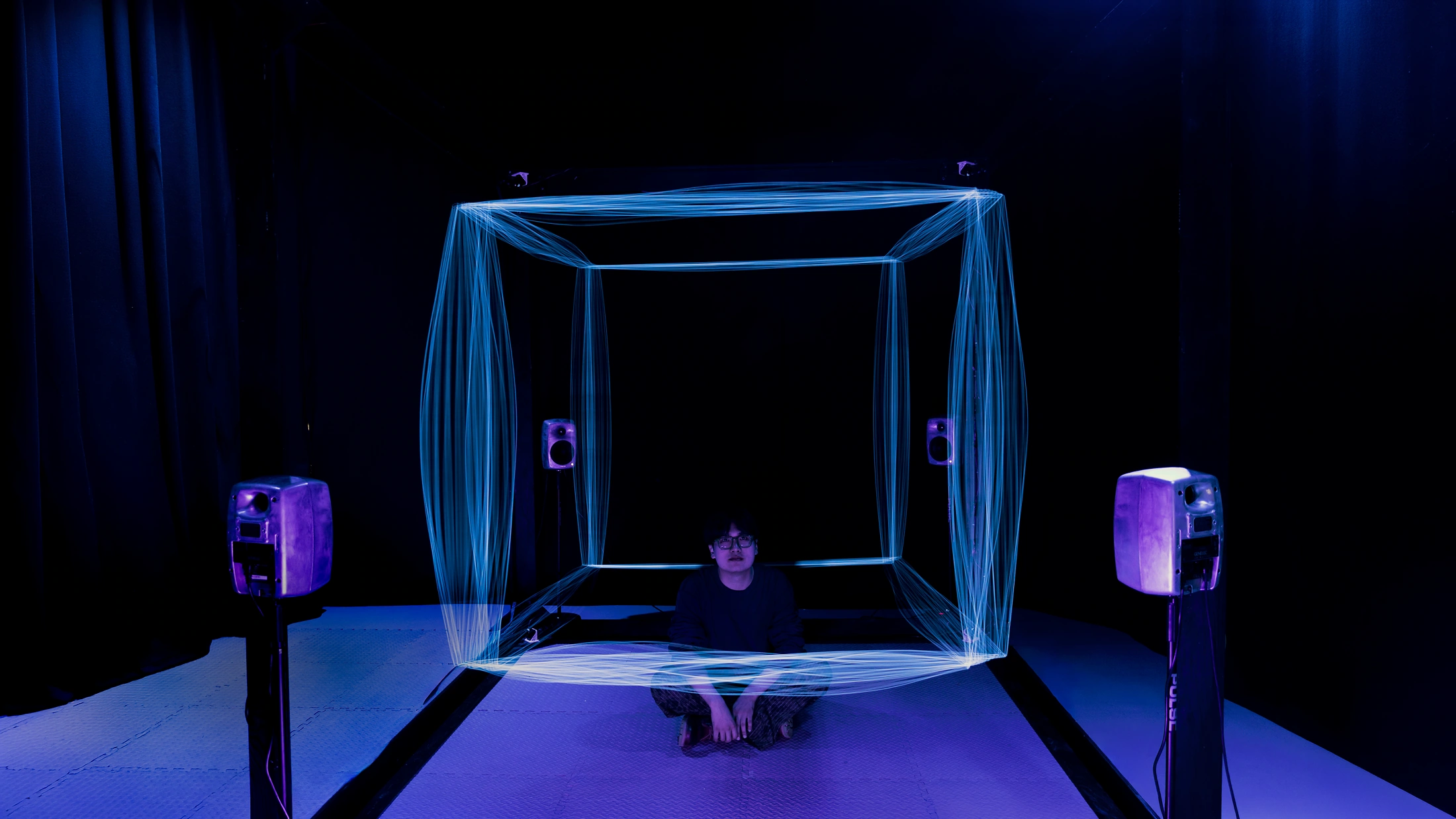
Sonic Elasticity is an interactive installation exploring how controlled sensory conditions construct and reshape spatial perception. Drawing on the geometric logic of the tesseract, it uses time as a dimension of perceptual change. An elastic cube expands and contracts alongside a four-channel soundscape, shifting judgements of distance, scale, and boundaries through synchronisation and deviation.
- My contribution
- Installation design and fabrication within a collaborative project
- Project stage
- Research, model iterations, physical installation, and audiovisual programming
Prediction and perception
When our predictions of space fail, how is perception reconstructed?
The brain continuously predicts sensory input rather than passively receiving information. Repeated rhythms, scales, and spatial relationships establish stable expectations. Mismatches between prediction and incoming stimuli prompt perception to reorganise.
Can a room feel larger than its physical dimensions? Can time seem to accelerate or slow down? These questions position illusion as a means of revealing and intervening in perceptual reconstruction through subtle but perceptible changes.
Repetition, expectation, and deviation
Repetition establishes regularity and a pattern that participants use to anticipate what happens next. Disruption makes previously reliable cues inconsistent, requiring a new interpretation of the environment.
Making perceptual change spatial
Visual and auditory cues become a controllable sequence of change. Transforming frames, light points, and boundaries allow participants to encounter the formation and revision of their spatial expectations.
Research and cognitive framework
ITPRA: the temporal structure of expectation
Huron’s Sweet Anticipation introduces the ITPRA model: Imagination, Tension, Prediction, Reaction, and Appraisal. It informs how repetition establishes expectations and how deviation produces immediate responses and subsequent reassessment.
Space and time provide direct sensory cues. The project translates this cognitive framework into changes in rhythm, distance, and scale, introducing controlled deviation within a stable pattern.
How sound shapes time and space
Rhythm and unexpected events
Repeated rhythms establish temporal expectations. Unexpected events become salient and may alter judgements of duration.
Soundscape
R. Murray Schafer’s soundscape concept informs a continuous environment of layered sounds in which listeners can establish reliable expectations.
Echoes and spatial scale
Echo timing, intensity, and decay provide cues to distance and spatial extent. Altered delay and reverberation suggest expansion or compression.
From fixed illusions to dynamic space
Ames room
From a fixed viewpoint, irregular geometry appears regular, revealing the role of visual references in judgements of scale.
Spazio Elastico
Gianni Colombo’s elastic lines, dark room, and movement destabilise boundaries and turn viewing into a bodily, dynamic experience.
Tesseract
The three-dimensional projection of four-dimensional geometry reconfigures boundaries and volumes, informing relationships between inner and outer frames.
Translating cognition into space
Active prediction, statistical regularities learned through repetition, and reorganisation after violated expectations become a three-stage experience: establish a predictable audiovisual relationship, gradually separate sound from space, and invite reassessment through new cues.
Establish a pattern
Repeated rhythms and scale relationships establish stable cues.
Form expectations
Participants learn to anticipate subsequent changes in sound and space.
Controlled deviation
Alter their correspondence so existing judgements require revision.
Perceptual experiments and physical model
The sound experiment used two stone-impact tracks. One accelerated before becoming irregular; the other added further sound elements. Participants estimated elapsed time, producing varied subjective durations that informed subsequent rhythm studies.
Spatial trials placed fluorescent frames in a dark room and combined fixed observation, bodily movement, and manual adjustment. Model tests explored how elastic structure, viewing position, and lighting affect the visibility of changing boundaries.
1:5 physical model
A scale model made with wood, elastic cord, fluorescent paint, a UV lamp, and metal nails tested connections, tension, and transformation. It translated geometric proposals into an operable physical structure.
Four design iterations
From a multisensory maze to a controlled relationship between space and sound.
Iteration 1 · Visual dominance
The first proposal was a maze of fluorescent grids combining moiré patterns, grating imagery, 3D mapping, material weaving, knots, and sound.
Competing stimuli lacked a clear hierarchy. Participants could not establish a stable pattern or readily interpret the source of change. The next iteration reduced visual competition and sought clearer relationships between cues.
Iteration 2 · Visual–auditory balance
The space became a linear corridor with a central “loom of time”, where stone impacts shifted from regular to irregular rhythms. Textured knots, vibrating lines, and sounding lines supported the experience, with sound becoming the primary cue.
Sound still lacked a continuous relationship with the overall structure. The link between rhythmic and spatial changes remained unclear, motivating an integrated sound field within one space.
Iteration 3 · Auditory integration
The proposal became a single cube whose scale changed through cord angle and tension. Four corner sound fields shared an underlying rhythm, while visually similar floor zones had different textures to create sensory mismatches.
The experience depended on movement between zones, dividing changes into local events. A continuous formation and disruption of expectation required spatial and auditory transformations that could unfold over time.
Iteration 4 · Pattern and disruption
The final proposal paired a fixed outer frame with a transformable inner frame, with the participant remaining at the centre. Sound initially matched spatial change and gradually diverged, allowing one position to experience different visual scales and acoustic distances.
Redundant floor textures and complex visual effects were removed. A central white sphere provided a reference, while a shared temporal sequence coordinated visual and auditory change to establish and then disrupt expectations.
Interaction between space and sound
Within the stable outer frame, the elastic inner cube changes size. Rhythm, delay, reverberation, and spatial distribution alter acoustic scale. The project first establishes synchronisation and then separates physical and acoustic space.
From four sound zones to a continuous field
Early sound studies included a mechanical clock, water clock, temple bell, and bell tower. A shared underlying rhythm provided continuity, while varying echoes and reverberation suggested spaces from compact to expansive.
Correspondence and mismatch
The comparison shows congruent and incongruent physical and acoustic scales: a small visual space can carry an expansive bell sound, while a larger space can contain a compact sound. The final version makes these relationships unfold continuously rather than requiring movement between zones.
Structure and fabrication
From a test frame to a fixed structure
The first full-scale test used tripods, elastic cord, and four speakers. Fluorescent paint improved visibility but altered the material appearance, so the later setup used white elastic cord under controlled dark-room lighting.
Modules and connections
A fixed timber frame provides a stable reference. Corner connections and winding mechanisms transform the inner elastic cube. The design combines modular assembly, timber joints, cord nodes, brackets, and motor-driven rollers.
Fabrication process
Fabrication progressed from frame prototypes and joint tests through timber cutting, tab-and-slot connections, elastic cord installation, roller production, drilling, and assembly. The nine-step process board connects structural drawings with workshop photographs.
Completed physical framework
The completed outer structure forms a stable boundary in the black-box environment. Elastic lines, corner joints, and winding paths constitute a system for continuous, smooth changes in scale.
Transformation system and control
Letting sound drive spatial transformation
Max/MSP sends transformation commands to Arduino, which controls clockwise and counterclockwise stepper-motor rotation. Winding and unwinding cord at four corner rollers expands or contracts the inner cube.
NEMA 17 stepper motors, DRV8825 drivers, flange couplings, and 3D-printed rollers form the mechanism. Serial commands connect motor actions with the audio program so audiovisual relationships can be adjusted within a shared timeline.
Sound design and audiovisual integration
From regular to irregular rhythm
The final sound design uses stone impacts. The complete audio sequence lasts 300 seconds, with regular rhythm for the first 45 seconds before becoming irregular. Clear attacks support added echoes and comparisons of reflection and decay across simulated spaces.
Compact acoustic spaces use more direct, dry sound, while expansive spaces add echo layers and longer decay. Rhythm affects temporal expectation and the sound field affects spatial judgement, with correspondence and deviation coordinated within one sequence.
Max/MSP version 1
Version 1 imported four sounds and used Spat5 to position virtual sources before speaker output. Source positions were adjusted manually, and spatial cues relied mainly on volume, without integrated reverberation, automated paths, or physical actuation.
From audio prototype to structural integration
The upgraded program uses a single source, adds echoes and reverberation, defines a default source path, and connects Arduino through serial communication. One program coordinates source movement, acoustic scale, and elastic-frame transformation.
Max/MSP version 2
Version 2 adjusts sound according to virtual source distance: within four metres it uses more direct sound and higher volume; beyond that threshold it adds echoes and reduces volume. This is a distance in the programmed acoustic environment, not the dimensions of the physical frame.
Yellow annotations identify added functions and blue annotations indicate the original logic. The Arduino connection allows acoustic and physical scale to align or gradually diverge as designed.
Three scale states
Small, medium, and large states connect Spat5 source positions with the physical frame. Audiovisual agreement establishes expectations, while gradual disagreement invites spatial judgements to reorganise around new cues.
Installation experience and film
Standby · Establishing spatial references
Elasticity · Tension and changing boundaries
Motion · Overlapping scales and boundaries
Reference · The observer at the centre
Installation film
Watch sound, the elastic framework, and participants interact within one space. Enable audio after playback.
Bartlett School design project · Collaborative installation and film
Explore more
Back to all work
The Big Bang Stigma
Read case studyTranslating research on illness stigma into an interactive journey through identity, recruitment, and livestream performance.

Blind Dating Market Festival
Read case studySix connected scenes explore how self-presentation, conditional matching, and social judgement shape intimate relationships.